CHAPTER THREE
Balancing Business Objectives with User Autonomy
Digital Editorial Adaptation
Organizations don't build trust by demanding attention.
They build it by earning participation.

Most organizations measure engagement through conversion metrics.
Customers experience engagement differently.
They experience interruptions.
Distractions.
Moments that either support or compete with the reason they came in the first place.
This project began with a simple question.
Can organizations improve business outcomes without asking customers to surrender control?
Rather than redesigning an email capture experience, the work became an exploration of how organizations earn participation by respecting customer autonomy.
The project looked like conversion optimization.
It turned out to be about organizational behavior.
EXECUTIVE SUMMARY
Challenge
The project began as an initiative to improve email acquisition and customer engagement through a more effective promotional experience. Initial assumptions suggested that increasing visibility would naturally improve subscription performance, but behavioral evaluation revealed that the challenge extended far beyond marketing optimization.
Approach
I led a behavioral UX strategy engagement combining experience evaluation, stakeholder collaboration, interaction analysis, customer journey mapping, behavioral design principles, and strategic reframing to better understand how organizations can improve business outcomes while respecting customer autonomy.
Outcome
The engagement produced a research-informed engagement strategy supported by behavioral UX evaluation, adaptive interaction models, progressive engagement flows, personalization recommendations, and implementation-ready experience concepts. More importantly, it established the principle that organizations build stronger relationships by earning participation rather than demanding attention.
“Every meaningful transformation begins with a better question.”
PROJECT SNAPSHOT
Role
UX Strategist
Product Designer
Focus
Behavioral UX Strategy, Customer Autonomy, Experience Design, Conversion Optimization
Methods
Behavioral Evaluation, Journey Mapping, Stakeholder Workshops, Interaction Design, Research Synthesis, Service Design
Deliverables
Behavioral UX Evaluation, Adaptive Engagement Strategy, Interaction Framework, Personalized Experience Concepts, Implementation Recommendations
Timeline
Project Engagement (Placeholder)
Industry
eCommerce, Digital Experience, Customer Engagement
DISCOVERY
The Question That Changed Everything
Organizations often begin optimization efforts by asking how to improve performance.
This project began by questioning whether we were measuring the right thing in the first place.
The original objective seemed straightforward.
Increase email subscriptions.
Improve marketing performance.
Drive stronger business results.
But behavioral evaluation suggested something far more important.
The experience wasn't underperforming because customers couldn't see it.
It was creating friction because it competed with their intent.
That realization redirected the entire engagement.
How do we persuade more people to subscribe?
How do we create an experience people willingly choose to engage with?

What We Thought We Were Solving
At first glance, every conversation pointed toward the same objective.
Increase visibility.
Improve conversions.
Capture more subscribers.
Every discussion naturally focused on optimizing what people could already see.
Questions quickly emerged.
• How can the banner attract greater attention?
• How can subscriptions increase?
• Which interaction patterns improve conversion?
• How can promotional messaging become more noticeable?
Each question assumed that greater visibility would naturally produce stronger engagement.
Behavioral analysis suggested we were solving the wrong problem.
Visibility isn't the same as engagement.
Attention isn't the same as trust.
Better questions create better products.

Problem Statement ("How Might We...")
The original challenge focused on improving promotional visibility.

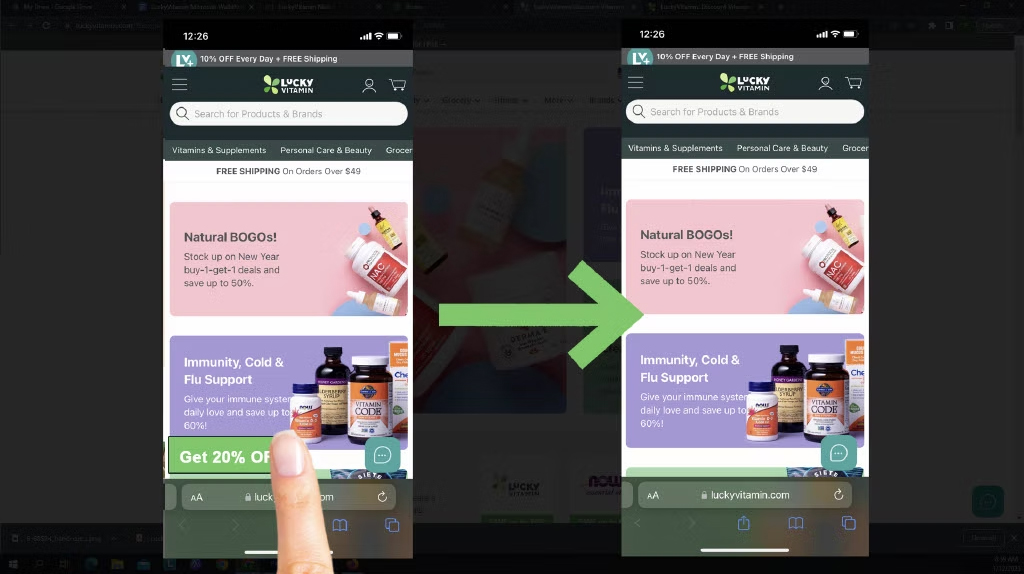
Existing Embedded Banner
Behavioral friction emerged not from the message itself, but from how the interaction interrupted the browsing experience.

Current State Experience
The existing interaction prioritized visibility over customer choice.

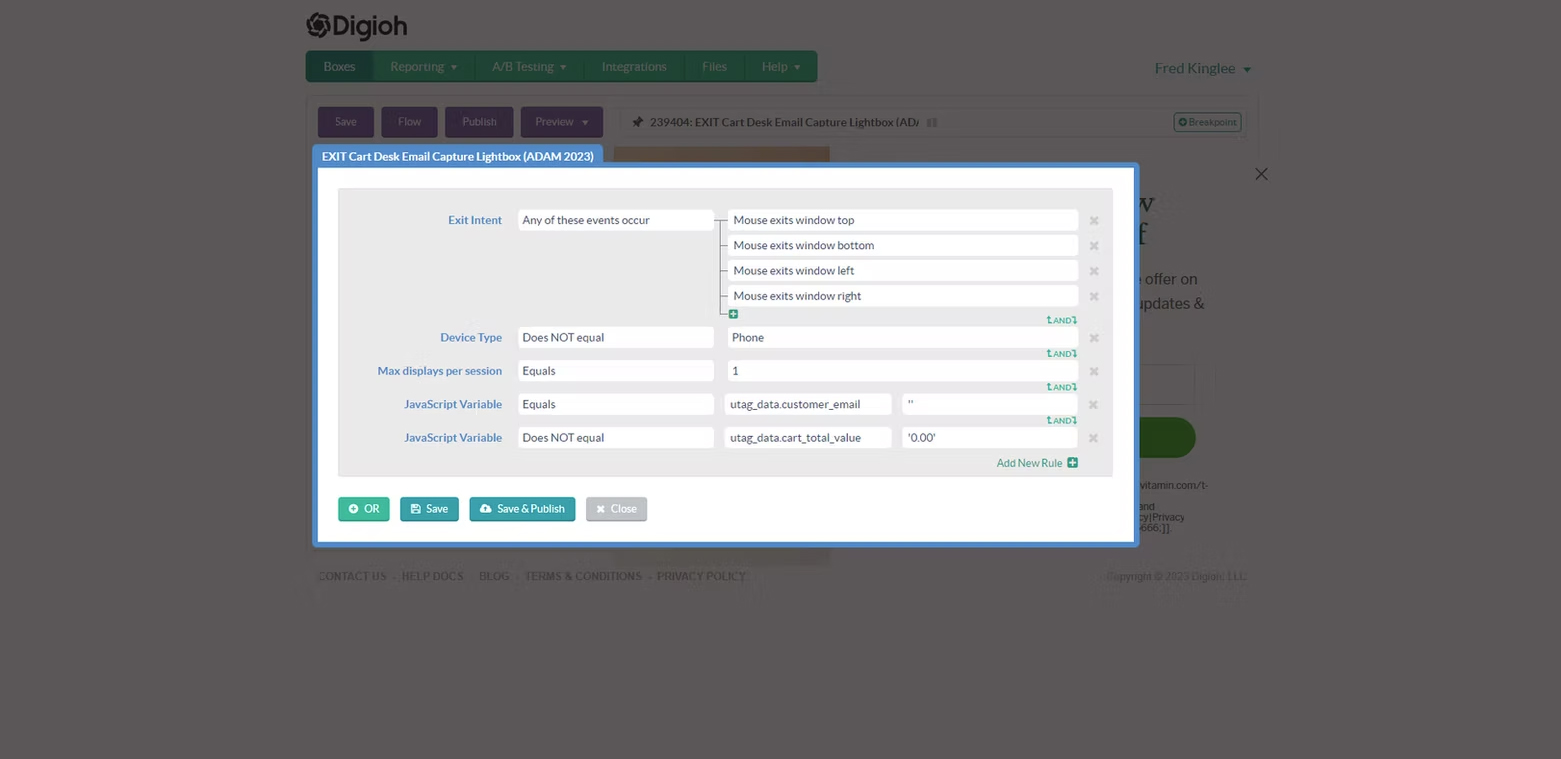
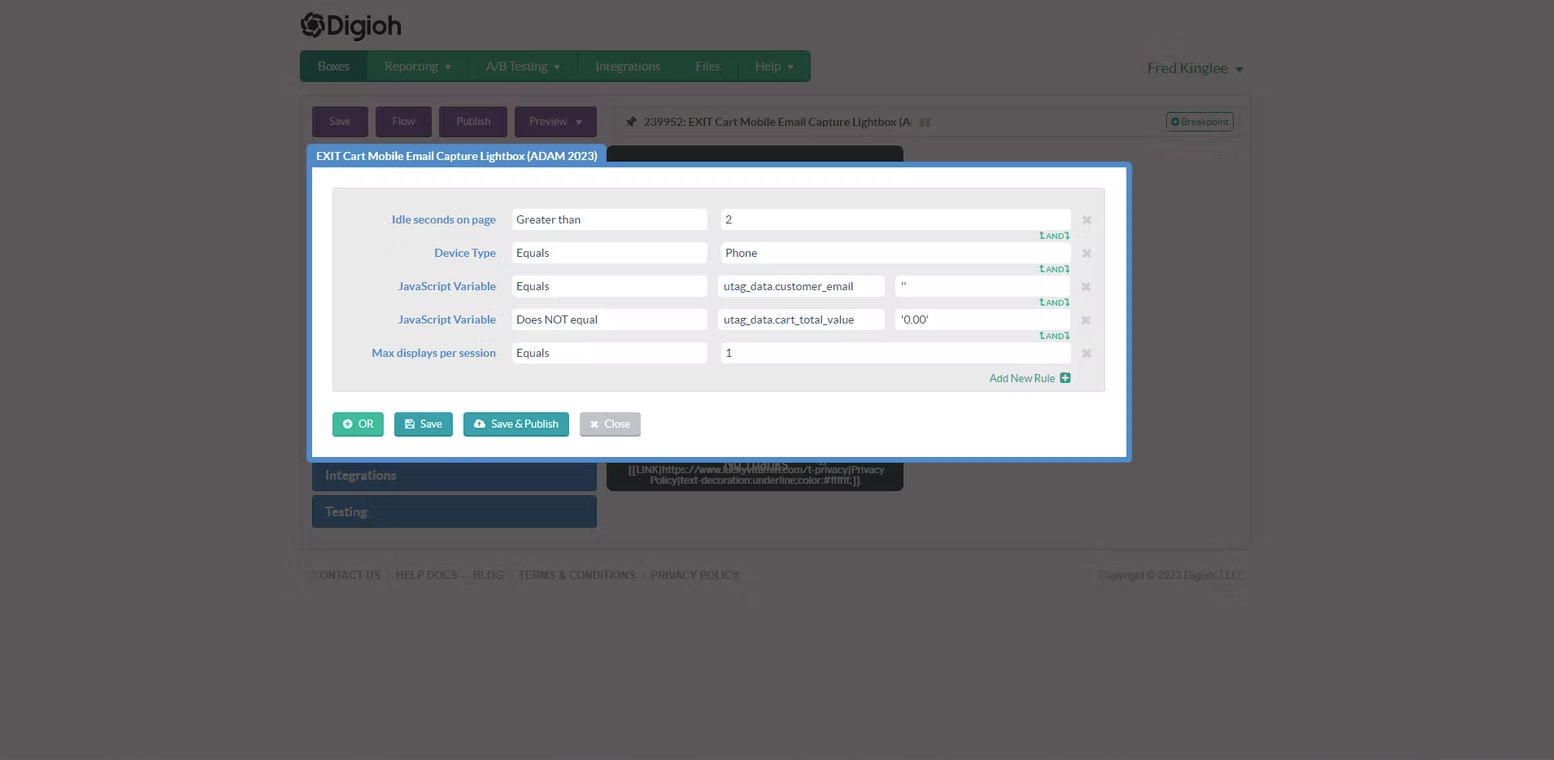
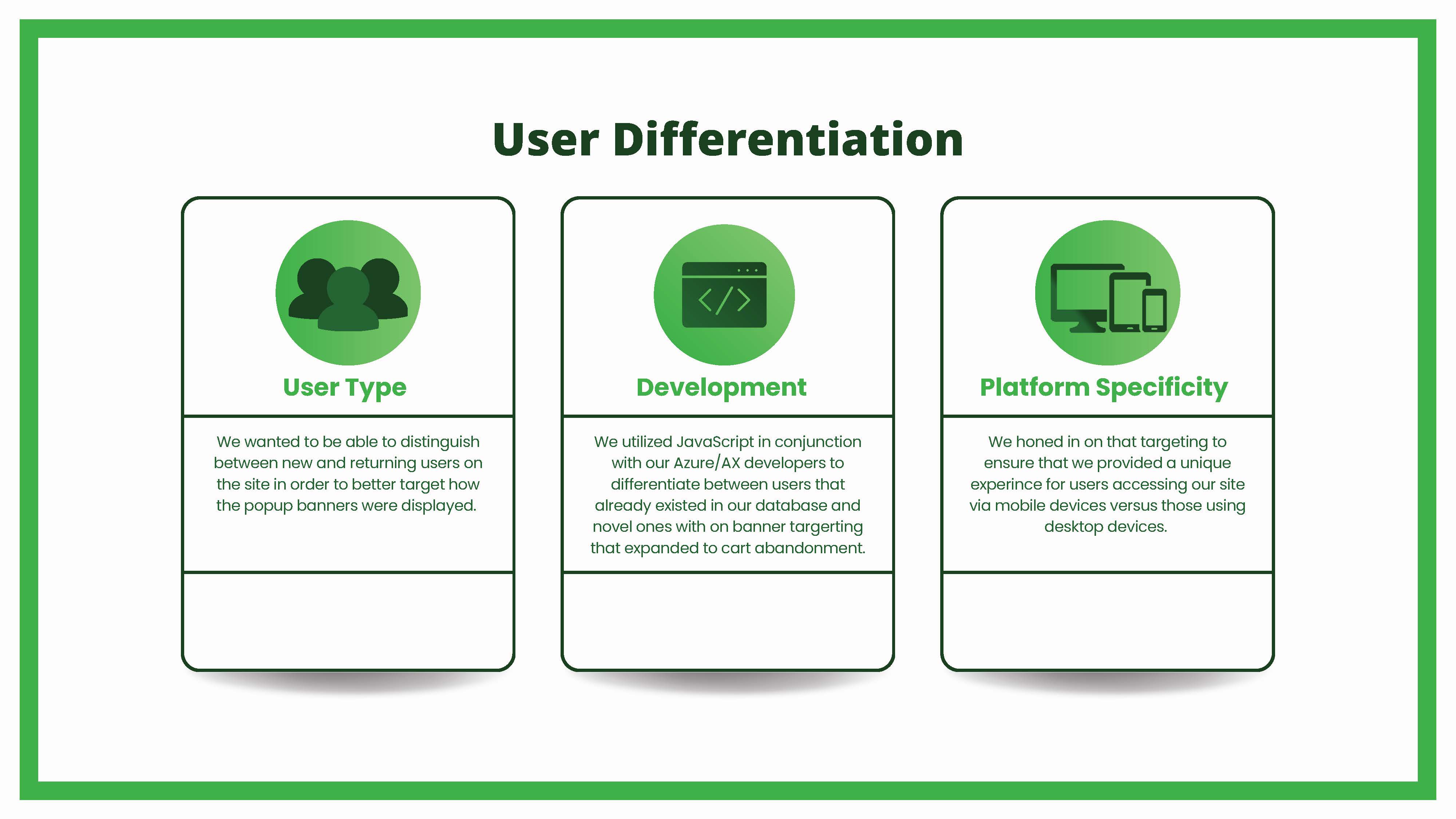
Supporting Team Planning Artifacts
Early planning materials documenting the project's initial direction before discovery reframed the challenge.
Rather than asking how to optimize a promotional component, I needed to understand the experience surrounding it.
When did promotional messaging become disruptive?
When did customers feel in control?
What behaviors reflected genuine willingness instead of resistance?
How could engagement remain visible without becoming intrusive?
The objective shifted away from marketing optimization and toward behavioral design.
Instead of maximizing exposure, the work began exploring the conditions under which people willingly choose to participate.
STRATEGIC EXPANSION
Looking Beyond the Interface
Behavioral analysis suggested we were solving the wrong problem.
The promotional component wasn't failing because people ignored it.
It struggled because it interrupted the experience people actually came to have.
That realization shifted the engagement beyond interface optimization.
Rather than asking how to improve a single promotional component, I needed to understand the broader experience surrounding it.
When did customers feel interrupted?
When did they feel in control?
What conditions encouraged participation instead of resistance?
The objective shifted away from marketing optimization and toward understanding the relationship between organizational intent and customer intent.
The interface was only one expression of a much larger system.

Discovery began by understanding the experience surrounding the interaction rather than the interaction itself.
Research Synthesis Board
My Role
My role wasn't to redesign an email banner.
It was to redesign the engagement system behind it.
As UX Strategist and Product Designer, I led the engagement from behavioral assessment through strategic experience design.
Rather than optimizing an individual interface, I focused on understanding the broader system shaping how organizations invite participation.
Responsibilities
Behavioral UX Evaluation
Experience Strategy
Interaction Design
Stakeholder Alignment
Customer Journey Analysis
Adaptive User Flows
Personalization Strategy
Implementation-Ready Recommendations
The First Major Insight
The most important insight came before the solution.
People don't remember being interrupted.
They remember whether they felt respected.
That observation fundamentally changed every design decision that followed.
The engagement stopped focusing on visibility.
It started focusing on agency.
Instead of asking how to encourage more interactions, the work began exploring how organizations could create conditions where participation felt voluntary.
Respect became a strategic design principle rather than a usability consideration.
That single realization established the foundation for every research activity that followed.
The most valuable UX insight wasn't about interfaces. It was about relationships.
Understanding behavior required moving beyond assumptions.
The next phase shifted from observation to evidence.
Rather than evaluating what the organization believed, discovery focused on understanding what customers actually experienced.
DISCOVERY
Discovery Changed the Question
Discovery didn't validate assumptions.
It replaced them.
The original objective was to improve an email capture experience.
Research quickly revealed that the interaction itself wasn't the problem.
The surrounding experience was.
Rather than evaluating whether customers noticed the interaction, I began asking a different question.
How did they experience it?
That subtle shift changed the direction of the entire engagement.
The work moved beyond conversion metrics and toward understanding behavior, context, timing, and trust.
Good research doesn't confirm what organizations believe.
It reveals what customers experience.
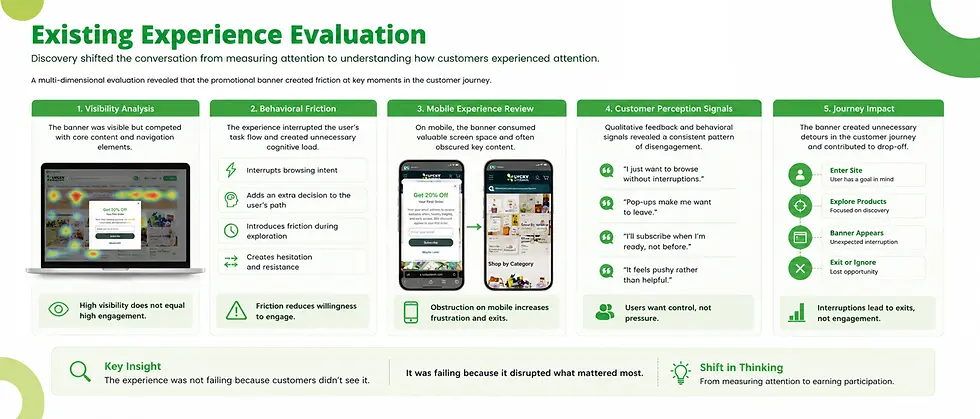
Existing Experience Evaluation
Discovery shifted the conversation from measuring attention to understanding how customers experienced attention.

Existing Embedded Banner
The original interaction emphasized visibility over customer control.

Experience Audit
Behavioral evaluation identified recurring patterns of unnecessary friction.

Current User Flow
Mapping the customer's journey revealed where engagement interrupted intent.

UX Evaluation Notes
Research observations documented the conditions that shaped the strategic reframing.
Several patterns emerged almost immediately.
• The interaction competed with users' immediate goals.
• It appeared regardless of customer intent.
• Dismissal options were limited.
• The experience assumed attention instead of earning it.
None of these observations suggested the promotional message was wrong.
They suggested the interaction lacked context.
Behavioral friction wasn't being created by the content.
It was being created by the experience surrounding it.
The interruption wasn't the insight.
Loss of agency was.
From Services to Systems
The deeper I examined the experience, the clearer it became that interruption was only the visible symptom.
The underlying issue was control.
Customers had little influence over when, how, or whether promotional messaging entered their experience.
That subtle shift fundamentally changed the relationship between user and organization.
Instead of inviting participation, the interface prescribed it.
Behavioral UX consistently demonstrates that people respond more positively when they retain ownership over the interaction.
That principle became the foundation for every decision that followed.
What initially appeared to be a marketing optimization effort evolved into a systems design challenge.
Every interaction existed within a broader ecosystem of customer expectations, organizational objectives, and behavioral context.
The work was no longer about improving a service.
It was about redesigning the system supporting that service.

User Journey Evaluation
Behavioral friction emerged when organizational timing conflicted with customer intent.
The project changed when we stopped asking how customers behaved and started asking why the experience produced those behaviors.
Understanding customer behavior was only part of the challenge.
The next phase required understanding the organization itself.
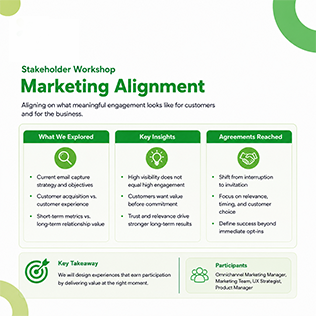
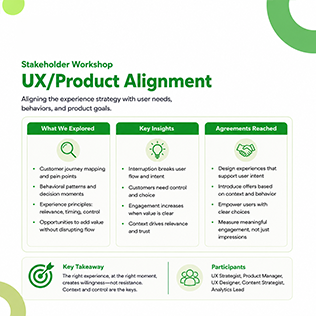
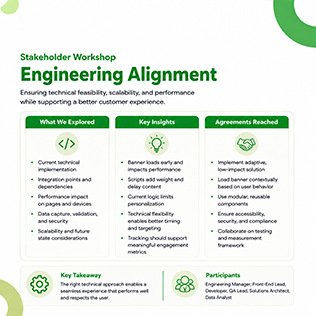
Marketing, product, engineering, and UX each viewed success differently.
Discovery became the shared language that aligned them.
ALIGNMENT
Aligning Perspectives
Discovery extended beyond evaluating customer behavior.
It also required understanding the organizational priorities shaping the experience.
Marketing prioritized visibility.
UX prioritized experience.
Engineering prioritized implementation.
Product prioritized measurable outcomes.
The challenge wasn't disagreement.
It was perspective.
Every discipline viewed the same interaction through a different lens.
None of those perspectives were inherently wrong.
They were simply incomplete in isolation.
Once those priorities were viewed as complementary rather than competing, a different path became possible.
Strategy begins when competing priorities become shared constraints.


Cross-functional workshops aligned marketing, UX, product, and engineering around a shared understanding of meaningful engagement.
Strategic Reframing
One realization brought every research activity together.
The project wasn't fundamentally about email acquisition.
It was about permission.
Organizations often optimize for exposure.
Customers evaluate experiences through control.
Those perspectives are not mutually exclusive.
They simply require a different design philosophy.
The work stopped asking:
"How do we earn participation?"
That single question transformed every design decision.
Visibility became contextual.
Interaction became adaptive.
Personalization became behavioral.
Choice became a design requirement rather than an optional feature.
The project was no longer designing a better promotional component.
It was beginning to design an entirely different engagement strategy.

How Might We... Reframing
The defining shift—from maximizing visibility to earning participation.
“Research didn't just change the solution.
It changed the question the organization was asking.”
DELIVERABLES
Project Outcomes
This engagement produced a research-informed experience strategy supported by qualitative research synthesis, customer personas, journey maps, decision frameworks, experience concepts, and strategic UX recommendations.
These deliverables established a shared understanding of customer decision-making that enabled product, design, marketing, and engineering teams to prioritize future improvements around confidence, trust, and informed participation rather than visibility alone.
Behavioral UX Evaluation
Stakeholder Alignment
Experience Audit
Strategic Reframing
Journey Mapping
Adaptive Interaction Strategy
UX Evaluation Notes
Progressive Engagement Framework
Research Synthesis
Implementation Recommendations
Research established the strategy.
The next phase focused on translating those principles into tangible experiences.
Every interaction would now be evaluated through one simple question.
Does this experience earn participation?
SOLUTION
Designing for Participation
Behavioral research fundamentally changed the direction of the project.
The objective was no longer to optimize an existing promotional component.
It became designing an engagement framework centered on customer choice.
Every decision was evaluated against a single question.
Does this interaction respect the user's intent while still supporting the organization's objectives?
Respect isn't the opposite of conversion.
It's what makes sustainable conversion possible.
Rather than presenting every customer with the same promotional experience, the final strategy introduced multiple engagement pathways that adapted to behavior, context, and intent.
Participation became something to earn.
Not something to engineer.
From Interface to Framework
The deliverable wasn't a screen.
It was a strategy.
The engagement demonstrated that email acquisition should never be treated as an isolated interface component.
It functions as one expression of a broader engagement ecosystem.
That ecosystem considers:
• User intent
• Browsing behavior
• Contextual timing
• Progressive disclosure
• Personalization
• Customer autonomy
• Long-term relationship building
Every interaction became one decision within a much larger behavioral framework.
The work ultimately extended beyond interaction design.
It became an exercise in designing organizational behavior.

The experience adapts to customer behavior instead of forcing a single conversion path.
Good interaction design creates better experiences.
Great UX strategy creates better systems.


Designing for Resilience
The most valuable outcome of the engagement was not a redesigned promotional experience.
It was a framework capable of evolving alongside customer behavior.
Rather than prescribing one ideal interaction, the system established principles that could guide future experiences regardless of channel, campaign, or interface.
Every new engagement opportunity could now be evaluated through the same behavioral lens.
Is it contextual?
Is it respectful?
Does it preserve customer agency?
Can participation remain voluntary while still supporting meaningful business outcomes?
Designing for resilience meant creating a system that could continue learning long after this project concluded.
That principle transformed a tactical engagement into an organizational capability.

The solution wasn't a redesigned banner. It was a repeatable engagement framework.
The framework established how respectful engagement could be designed.
The final chapter explores why that distinction matters.
Not only for this project.
But for every organization seeking to build lasting relationships through digital experiences.
OUTCOMES
What Success Actually Looked Like
Success was never defined by increasing the visibility of a promotional component.
It was defined by improving the quality of the relationship between organizations and the people they serve.
The engagement demonstrated that stronger business outcomes do not require increasingly aggressive promotional tactics.
Instead, the work established a framework that enabled future engagement strategies to become more adaptive, contextual, and respectful.
The organization gained more than a redesigned interaction.
It gained a repeatable way of evaluating how customer experiences should be introduced, measured, and continuously improved.
Trust became a measurable business objective rather than an accidental byproduct of good design.

Strategic Framework Summary
Respecting customer autonomy strengthened both organizational alignment and long-term business outcomes.
The Bigger Lesson
Organizations often ask:
"How do we capture more attention?"
This project asked:
"How do we deserve more attention?"
That distinction fundamentally changes the role of UX strategy.
Design is no longer responsible for increasing interaction.
It becomes responsible for improving the quality of the relationship between organizations and the people they serve.
When organizations respect autonomy, stronger engagement naturally follows.
Business objectives and customer experience are not opposing forces.
They become mutually reinforcing when respect becomes part of the design process.
Respect isn't the opposite of conversion.
It is the foundation of sustainable conversion.
Why This Project Matters
At first glance, this project appears to document the redesign of an email capture experience.
Collectively, the work demonstrates something much larger.
A philosophy.
One where organizational growth and customer autonomy reinforce one another rather than compete.
The interface is simply the visible expression of that philosophy.
This engagement continues to shape how I approach product strategy, experience design, service design, and organizational transformation.
The most meaningful UX work rarely begins by asking how to improve an interface.
It begins by understanding how people experience the systems behind it.




Closing Reflection
Organizations do not build lasting relationships by demanding attention.
They build them by creating experiences people willingly choose to participate in.
Respecting user autonomy isn't a limitation on business performance.
It's one of its greatest competitive advantages.
When organizations design experiences that honor human intent, they earn something far more valuable than a conversion.
They earn trust.
CONTINUE TO CHAPTER FOUR
Designing for Long-Term Relationships
Meaningful customer experiences are not created through isolated interactions.
They emerge from systems that consistently reinforce trust, context, and shared understanding over time.
Chapter Four explores how those principles extend beyond individual touchpoints to shape long-term product strategy, organizational behavior, and enduring customer relationships.