CHAPTER FOUR
Modernizing Enterprise Knowledge Systems
Knowledge isn't valuable because it exists.
It's valuable because people can find it, understand it, and apply it.
This project began as an effort to modernize an enterprise SharePoint environment. Research revealed a different challenge entirely. The real problem wasn't where knowledge lived. It was how knowledge moved through the organization.

BVSS_Screen_1

THE ORGANIZATIONAL QUESTION
How do organizations share knowledge effectively?
Project Snapshot
Organization
The Vanguard Group
Role
UX Strategist • Product Designer
Focus
Enterprise UX
Information Architecture
Knowledge Systems
Strategic Theme
Organizational Learning
Primary Disciplines
Enterprise UX Strategy
Information Architecture
Taxonomy Design
Systems Thinking
Enterprise Learning
That question shaped every decision that followed.
Initially, the engagement appeared to focus on improving an existing SharePoint environment supporting cloud certification and Agile enablement.
Discovery changed the question.
Instead of redesigning pages, the work shifted toward understanding how knowledge flowed across people, teams, and systems.
That shift fundamentally changed the direction of the project.
THE REAL PROBLEM
The issue wasn't where knowledge lived.
The issue was how knowledge moved.
Across the organization, valuable knowledge already existed.
Training materials.
Documentation.
Certification pathways.
Operational standards.
The challenge wasn't creating more information.
It was helping people understand how everything connected.
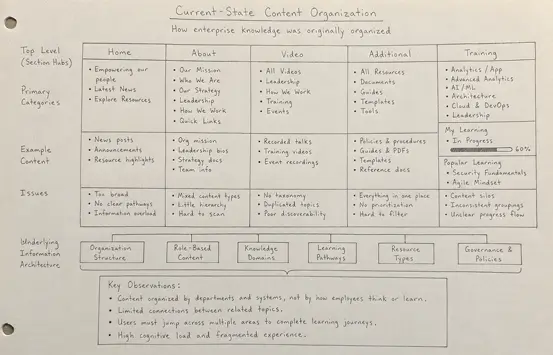
Research revealed that fragmented navigation reflected organizational structures more than the way employees actually learned.
The problem wasn't interface design.
It was knowledge architecture.


DISCOVERY THROUGH RESEARCH
Before proposing solutions, I needed to understand how knowledge actually moved.
Rather than beginning with interface improvements, the engagement focused on understanding how employees discovered, interpreted, and applied organizational knowledge throughout their daily work.
The objective wasn't simply to improve usability.
It was to improve how knowledge flowed throughout the enterprise.
My Role
I wasn't designing individual pages.
I was redesigning how knowledge moved across an enterprise.
Responsibilities
- Conduct stakeholder interviews
- Evaluate enterprise workflows
- Modernize information architecture
- Design taxonomy and navigation systems
- Develop role-based organizational structures
- Facilitate cross-functional collaboration
- Translate research into scalable enterprise recommendations
Throughout the engagement, the objective remained consistent:
Improve how knowledge moved between people, teams, and organizational systems rather than optimizing isolated interfaces.
Research Questions
- How were employees finding information?
- Where did learning pathways become fragmented?
- Which documentation created confusion?
- What increased cognitive load?
- Did navigation reflect employee mental models?
- What prevented knowledge from moving effectively across teams?
These questions intentionally shifted the engagement away from redesigning pages and toward improving how knowledge flowed throughout the organization.
REFLECTION
Interfaces organize information.
Information architecture organizes understanding.
The most important realization wasn't that the organization lacked knowledge.
It was that organizational complexity had outgrown the structures supporting it.
Improving navigation alone would never solve that challenge.
The organization needed a knowledge architecture capable of supporting learning, decision-making, and long-term capability.
That realization fundamentally changed how I approached enterprise UX.
NEXT
With the organizational challenge now reframed around knowledge flow rather than interface modernization, the next phase shifts into discovery.
The objective is no longer to redesign SharePoint.
It is to understand how organizational knowledge can become easier to discover, connect, and apply across the enterprise.
DISCOVERY
Discovery Changed the Question

Before redesigning where knowledge lived, I needed to understand how it moved.
Once the organizational challenge had been reframed, discovery shifted away from evaluating individual SharePoint pages.
Instead, the work focused on understanding how employees located information, completed learning pathways, and connected knowledge across multiple enterprise systems.
The objective wasn't simply to improve an intranet.
It was to understand how organizational knowledge was created, connected, and experienced across the enterprise.

What Discovery Revealed
Knowledge existed. Connections didn't.
Discovery revealed recurring patterns across the enterprise. Employees understood individual resources but struggled to connect them. Certification pathways lacked clear progression. Documentation reflected organizational structures more than employee mental models. Related information existed in separate locations with few meaningful relationships.
The organization didn't need more documentation. It needed stronger relationships between the knowledge it already possessed.
STRATEGY IN PRACTICE
Discovery wasn't about collecting information. It was about revealing relationships.
Discovery combined stakeholder collaboration, workflow analysis, content evaluation, and information architecture into one continuous learning process. The objective was to identify where organizational knowledge became fragmented and why employees experienced unnecessary friction while navigating enterprise learning resources.
Methods Applied
- Stakeholder Interviews
- Workflow Analysis
- Information Architecture Assessment
- Content Inventory
- Knowledge Mapping
- Enterprise UX Evaluation
Executive Value Created
Created visibility into organizational knowledge gaps while establishing a shared understanding of how fragmented information affected learning, collaboration, and operational efficiency.
STAKEHOLDER COLLABORATION
Every team understood its content. Few understood the entire system.
Enterprise knowledge spans multiple organizational functions, making collaboration central to discovery. Working alongside stakeholders across UX, engineering, learning, Agile enablement, and business leadership allowed the project to balance organizational requirements with employee needs.
Rather than optimizing individual stakeholder requests independently, conversations focused on developing a shared understanding of enterprise learning. These discussions revealed an important distinction. Every team believed they were contributing valuable information. Few teams understood how employees experienced the system as a whole.
That systems-level perspective fundamentally influenced the resulting architecture. The project shifted from organizing content ownership to organizing employee understanding.
MAPPING KNOWLEDGE RELATIONSHIPS
From Information to Understanding
The most valuable discovery wasn't missing information. It was missing relationships.
As research progressed, the work shifted away from improving individual pages and toward strengthening the connections between existing knowledge.
Employees needed:
• Clear learning pathways
• Consistent terminology
• Logical certification progressions
• Stronger contextual relationships
• Reduced duplication
• Navigation that reflected how people actually learned rather than how departments organized information.
Knowledge architecture became less about hierarchy and more about helping employees understand where they were, why they were there, and where they needed to go next.
The project began treating knowledge as a connected ecosystem rather than a collection of documents.


THE TURNING POINT
The Project Changed
SharePoint wasn't the product.
Organizational learning was.
Information architecture planning revealed the defining insight of the engagement.
The delivery platform had never been the real challenge.
Employees didn't need another repository.
They needed a system that helped them understand:
• What they needed to learn
• Why it mattered
• Where related knowledge existed
• How learning connected across disciplines
• How knowledge supported their day-to-day responsibilities
This was the moment the project stopped being an intranet redesign.
It became an enterprise knowledge architecture initiative.
STRATEGIC REFRAMING
Navigation became orientation.
Taxonomy became organizational language.
Pages became learning pathways.
Information architecture became enterprise capability.
Once the organizational challenge had been reframed, every subsequent design decision changed. The focus shifted from delivering content to enabling organizational learning. Instead of optimizing information delivery, the work strengthened the organization's ability to continuously learn, share knowledge, and scale expertise across teams.

REFLECTION
Thoughtful information architecture does more than improve usability.
It enables organizations to learn.
Discovery fundamentally changed how I think about enterprise UX. Organizations rarely struggle because expertise is unavailable. They struggle because expertise becomes increasingly difficult to locate, connect, and apply as complexity grows. That realization expanded my perspective from designing digital products to designing systems that help organizations think, learn, and evolve more effectively.
NEXT
Designing Organizational Capability
With the knowledge architecture established, the next phase focused on translating strategic thinking into a modern enterprise experience. The objective was no longer to improve individual pages. It became creating an information ecosystem that reduced friction, strengthened learning, and enabled employees to move confidently through increasingly complex enterprise knowledge. The solution that followed was built upon the strategic foundation established through discovery.
SOLUTION EVOLUTION
Designing for Organizational Learning
The solution wasn't a better SharePoint experience.
It was a better way for an organization to learn.


Once the challenge had been reframed around knowledge flow rather than platform modernization, every design decision changed. The objective was no longer to redesign individual pages. It became designing an enterprise knowledge ecosystem that helped employees discover information, understand relationships, and navigate increasingly complex learning pathways with confidence. Every decision was guided by one question:
Does this improve how organizational knowledge is understood, connected, and applied?


Enterprise Knowledge Ecosystem
Knowledge becomes more valuable when its relationships become clearer.
The resulting experience reorganized enterprise knowledge around employee understanding rather than departmental ownership.
The redesigned system introduced:
• Role-based navigation
• Simplified taxonomy
• Contextual relationships between learning resources
• Clear certification pathways
• Improved content hierarchy
• Consistent organizational language
• Reduced duplication across documentation
Rather than expecting employees to assemble knowledge independently, the experience guided them through a connected learning journey that reduced cognitive effort while increasing confidence.
BEYOND INTERFACE DESIGN
Enterprise UX Shapes Organizational Learning
Enterprise UX extends beyond interface design.
It shapes how organizations learn.
Every navigation decision influences discoverability.
Every taxonomy decision influences comprehension.
Every structural relationship influences organizational capability.
Viewed together, these elements create an environment where learning becomes easier, expertise becomes more accessible, and institutional knowledge becomes more resilient.
The solution therefore represented more than an improved digital experience.
It represented an investment in organizational capability.
ORGANIZATIONAL IMPACT
The platform changed.
The organization changed with it.
Although the visible deliverables consisted of redesigned enterprise interfaces and navigation systems, the broader organizational outcomes extended well beyond usability improvements.
The initiative strengthened the organization's ability to:
- Organize institutional knowledge
- Improve employee onboarding and learning
- Reduce duplicated effort
- Support certification pathways
- Create shared organizational language
- Increase discoverability across enterprise resources
- Establish a scalable foundation for future enterprise learning initiatives
The value therefore resided not only in the redesigned platform, but in the organizational capability that the platform enabled.
EXECUTIVE PERSPECTIVE
Technology Doesn't Create Organizational Learning
Technology doesn't create organizational learning.
Structure does.
Organizations frequently invest in new platforms expecting technology alone to improve knowledge sharing. This engagement demonstrated that technology is only one component of organizational learning. The greater opportunity lies in designing the structures through which knowledge moves. When information architecture reflects how people think rather than how organizations are structured, knowledge becomes easier to discover, easier to understand, and easier to apply. The project therefore shifted the organizational conversation away from maintaining content toward designing systems that continuously support learning.
Key Insight
Organizations don't become more capable because they have more information. They become more capable because people can consistently find, understand, connect, and apply that information.
REFLECTION
Designing Systems That Help Organizations Learn
Organizations experience knowledge the way people experience products.
Earlier chapters explored understanding people, research, and behavior. This project introduced a different realization. Information loses value when people cannot find it, understand it, or connect it to meaningful action. That insight fundamentally changed how I viewed enterprise UX. Information architecture became more than navigation. It became a strategic capability for organizational learning.
Portfolio Progression
Every project expanded the question I was trying to answer. Each experience built upon the insights that came before it, gradually shifting my perspective from designing interfaces to designing organizational capability.
Understanding People
↓
Building Trust Through Research
↓
Balancing Human and Business Needs
↓
Organizing Knowledge
This project represents a turning point in my work. The focus expands beyond designing individual experiences toward designing environments that enable organizations themselves to learn more effectively. What appears to be an enterprise intranet modernization initiative is, in reality, a case study about organizational knowledge. The platform is simply the visible interface. The deeper work involved redesigning the relationships between people, information, learning, and organizational capability. Today, that perspective continues to shape how I approach enterprise transformation. Rather than asking where information should live, I ask how knowledge should move.
Evidence of Practice
Expand to view the capabilities, disciplines, and strategic competencies demonstrated throughout this engagement.
Disciplines Demonstrated
- Stakeholder Interviews
- Enterprise Research
- Information Architecture
- Taxonomy Design
- Workflow Analysis
- Knowledge Mapping
- Navigation Strategy
- Systems Thinking
- Enterprise UX
- Content Strategy
Strategic Capabilities
- Enterprise Strategy
- Organizational Systems Design
- Knowledge Management
- Cross-Functional Leadership
- Strategic Facilitation
- Capability Building
- Organizational Transformation
FINAL PERSPECTIVE
LOOKING AHEAD
Organizing Knowledge Was Never the Final Objective
It was the foundation.
This project answered an important question.
How do organizations share knowledge effectively?
The next chapter explores what happens after knowledge has been organized.
If this engagement focused on designing systems that help people access and understand knowledge, the next examines how organizations transform that knowledge into sustained behavioral change.
Knowledge alone doesn't create transformation.
Organizations must learn together.
The scale increases.
The philosophy remains consistent.
CLOSING THOUGHT
Knowledge becomes valuable only when people can confidently discover it, understand it, and apply it.
Enterprise UX extends beyond designing digital interfaces.
It is equally about designing the structures that allow organizations to learn, collaborate, and continuously improve.
When knowledge flows effectively, organizations become more capable.
When organizations become more capable, transformation becomes sustainable.
That principle continues to guide how I approach enterprise systems, organizational strategy, and the design of environments where both people and knowledge can scale together.
Continue Reading
Explore how strategic design evolves from organizing knowledge to enabling lasting organizational change.