Chapter One
Designing a Community-Centered Nutrition Education Ecosystem
How do we design healthier communities without assuming we already understand what people need?
This project opens the portfolio because it introduced a philosophy that continues to shape every chapter that follows.
It began as a question about nutrition.
It became an exploration of people, trust, behavior, and the systems surrounding everyday decisions.
Before designing anything, I first needed to understand the people expected to live within the solution.
That distinction changed everything.
Meaningful design rarely begins with solutions.
It begins with understanding.

EXECUTIVE SUMMARY
Challenge
The project began as an initiative to improve nutrition education within underserved communities. Early assumptions suggested that increasing access to information would naturally encourage healthier choices, but research revealed that the challenge extended far beyond education.
Approach
I led a community-centered research effort combining stakeholder interviews, secondary research, systems mapping, collaborative workshops, behavioral analysis, and service design to understand the relationships influencing long-term health outcomes.
Outcome
The engagement produced a research-informed strategic proposal for a sustainable community nutrition ecosystem supported by behavioral design principles, stakeholder collaboration, implementation planning, and systems thinking. More importantly, it established the philosophy that understanding people must precede designing systems.
PROJECT SNAPSHOT
Organization
PHL GUD (Feel Good)
Role
Design Strategist | Research Lead
Focus
Human-Centered Design
Strategic Design
Community Research
Behavioral Design
Systems Thinking
Service Design

The Question That Changed Everything
At first glance, the challenge appeared straightforward.
Improve nutrition education.
Increase access to healthier food.
Encourage healthier choices.
Research quickly revealed something different.
Those objectives described symptoms—not the underlying organizational problem.

Food Desert Definition

National Food Access Statistics

Philadelphia Food Access Statistics

Census & Poverty Data

Childhood Poverty

Obesity Statistics
The first problem we identified wasn't nutrition.
It was our understanding of the problem itself.
Looking Beneath the Surface
Community research revealed that healthier outcomes depended on far more than information.
Behavior was shaped by:
• Trust
• Education
• Family
• Environment
• Community Ownership
• Institutional Relationships
The project gradually shifted away from asking:
How do we educate people?
toward a much larger organizational question:
What conditions allow healthier behaviors to become sustainable?
That single shift transformed every strategic decision that followed.
The greatest insight from this stage was not identifying a solution.
It was recognizing that the original framing of the problem was incomplete.
Communities rarely experience challenges one variable at a time.
They experience interconnected systems.
Understanding those relationships required slowing down, resisting premature solutioning, and allowing research to reshape the direction of the project.
Understanding always comes before optimization.

Cognitive Development Research
Looking Beyond Services
The contextual research explained what was happening.
The next step was understanding why.
Rather than immediately designing a solution, I shifted into community immersion, empathy research, and participatory discovery.
The objective became remarkably simple:
Understand lived experience before proposing change.
MY ROLE
Design Strategist
Research Lead
Community Facilitator
Systems Thinker
Primary Responsibilities
- Community immersion
- Stakeholder engagement
- Qualitative research
- Behavioral observation
- Strategic synthesis
- Experience strategy
Research wasn't validating assumptions.
It was challenging them.
COMMUNITY BEFORE CONCEPTS
Discovery began by participating.
A neighborhood cleanup initiative became the first opportunity to observe how residents interacted with one another, how community pride influenced participation, and how collective ownership shaped behavior.
At first glance, the activity appeared unrelated to nutrition.
In reality, it revealed something far more important.
Communities engaged more deeply when they believed they were contributing to something larger than themselves.
That insight influenced every strategic decision that followed.
Communities don't become stronger because someone brings them answers.
They become stronger when they help shape those answers together.

Community Cleanup Initiative

The Focus (As Opposed to the Flare)
The strongest research often begins before formal interviews.
Sometimes the most valuable insights emerge simply by participating alongside the people you're hoping to understand.
Discovery Changed the Question
Research uncovered an unexpected pattern.
Most participants already understood the importance of healthier eating.
Knowledge was not the primary barrier.
The challenge was creating environments capable of reinforcing healthier behaviors over time.
The project changed direction.
It was no longer about improving education.
It had become about designing systems that supported lasting behavior.

LEGO Co-Creation Workshop
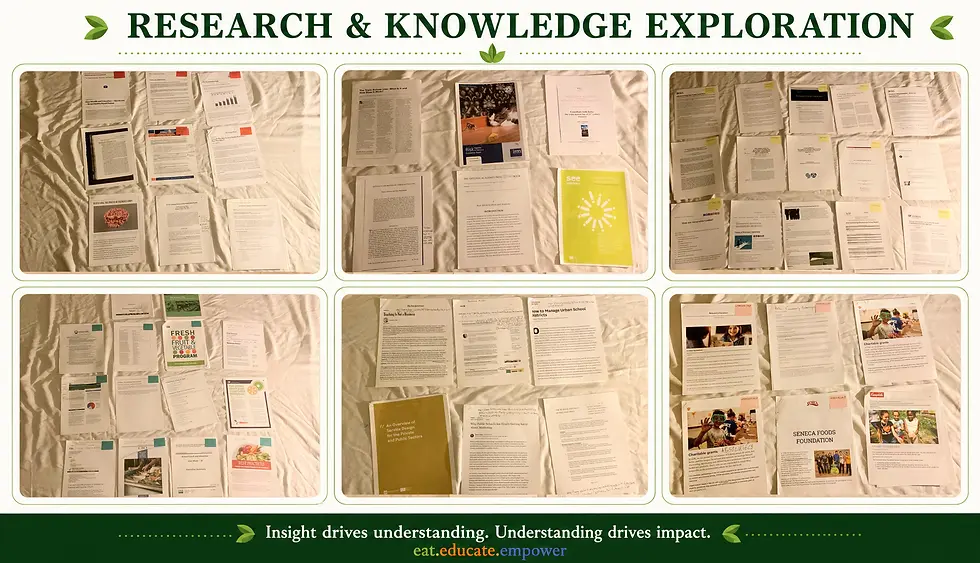
Literature Review & Research Foundation
Communities didn't need more information.
They needed systems that continually reinforced healthier decisions.
Designing With the Community
Rather than positioning residents as recipients of expertise, they became partners in shaping future possibilities.
Participatory workshops explored:
• Shared priorities
• Community barriers
• Future experiences
• Collaborative idea generation
The objective was never to evaluate finished concepts.
It was to understand how residents themselves defined success.
That distinction fundamentally changed the strategy.

Community Ecosystem Diagram
The strongest solutions weren't designed for the community.
They were designed with it.
Research did not simplify the challenge.
It expanded it.
The deeper the investigation became, the clearer it was that meaningful change would require designing relationships—not simply designing services.
Rethinking Community
The project began with one question.
How do we improve nutrition education?
Research ultimately led to a better one.
How do we create the conditions necessary for healthier behaviors to become sustainable?
That single shift transformed the project.
Nutrition education became one component within a broader ecosystem connecting students, families, educators, healthcare organizations, funding partners, and public institutions.
The solution was no longer a program.
It became an interconnected system designed to strengthen relationships that could sustain healthier decisions over time.

PROJECT OUTCOMES
PROJECT OUTCOMES
This engagement produced a research-informed experience strategy supported by qualitative research synthesis, customer personas, journey maps, decision frameworks, experience concepts, and strategic UX recommendations.
These deliverables established a shared understanding of customer decision-making that enabled product, design, and business teams to prioritize future improvements around confidence, trust, and informed purchasing rather than navigation alone.
Deliverables Produced
Research synthesis
Community personas
Behavioral insights
Journey maps
Decision frameworks
Community ecosystem model
Experience concepts
Strategic UX recommendations
Systems-thinking framework
Implementation strategy
“Changing the question changed the entire solution.”
Strategic Reframing
The greatest outcome of the research was not a refined service.
It was a fundamentally different way of defining the problem.
Rather than asking how an organization could educate a community, the work explored how an entire community could collectively reinforce healthier behaviors.
This shift transformed every recommendation that followed.
Programs became relationships.
Services became systems.
Education became one capability within a much larger ecosystem of trust, participation, collaboration, and shared responsibility.
Designing the ecosystem was never the objective.
It was the natural result of understanding the conditions required for healthier behaviors to become sustainable.
Once those relationships became visible, the direction of the solution became remarkably clear.
IMPLEMENTATION & SUSTAINABILITY
Designing for What Happens Next
By the conclusion of discovery, the work had evolved beyond defining a community program.
The emerging ecosystem connected students, families, schools, healthcare providers, community organizations, local businesses, and funding partners around a shared purpose.
The next question became:
How could those relationships be organized so that the system remained practical, collaborative, and sustainable?
The answer required more than a compelling concept.
It required an organizational model capable of translating community insight into coordinated action.

From Provider to Steward
The ecosystem changed the role of every participating organization.
No single institution would provide the complete solution.
Schools could support education and reinforce healthier behaviors.
Healthcare providers could contribute expertise, prevention resources, and trusted guidance.
Community organizations could strengthen participation, local relevance, and continuity.
Businesses and funding partners could help sustain the system operationally.
Families and residents would not simply receive services.
They would help shape priorities, reinforce behaviors, and maintain community ownership.
The role of the organization therefore shifted from being the sole provider of change to becoming a steward of the relationships capable of sustaining it.
Students and Families
Participate in shaping priorities, experiences, behaviors, and definitions of success.
Schools and Educators
Support education, reinforcement, accessibility, and sustained engagement.
Healthcare Providers
Contribute trusted expertise, preventative guidance, and connections to community health resources.
Community Organizations
Strengthen participation, cultural relevance, relationship-building, and local continuity.
Local Businesses
Support access, partnerships, incentives, resources, and neighborhood-level participation.
Funding Partners and Public Institutions
Provide financial support, infrastructure, strategic alignment, and long-term institutional stability.
Sustainable change did not depend on one organization doing everything.
It depended on every participant strengthening the system together.

Designing for Resilience
The ecosystem also required a model for endurance.
Community impact could not depend entirely on one program, one funding source, one leader, or one moment of participation.
Sustainability therefore became part of the design rather than a consideration added after the concept was complete.
The proposed model connected community value with operational viability through shared ownership, institutional collaboration, diversified support, and continued participation.
The objective was not simply to launch an initiative.
It was to establish conditions that could remain useful as community needs, partnerships, resources, and leadership changed over time.
Organizational Impact
This project remained a strategic design proposal rather than a deployed nonprofit initiative.
Its value is therefore measured by the organizational thinking it produced.
The work established:
• a research-informed behavioral design framework;
• a scalable community ecosystem;
• a participatory research model;
• an implementation strategy grounded in collaboration;
• a systems-based approach to sustainable
community impact.
The project demonstrated that meaningful public health innovation begins by understanding people before designing programs.
Better systems begin with better understanding.
What Success Actually Looked Like
This project remained a strategic design proposal rather than a deployed nonprofit initiative.
Its success was never measured by the launch of a single program.
Instead, it was measured by the quality of the thinking it produced.
Research transformed assumptions into understanding.
Understanding became strategy.
Strategy became an ecosystem capable of supporting healthier decisions through collaboration rather than isolated intervention.
The project demonstrated that meaningful organizational change begins long before implementation.
It begins by learning how people experience the systems already shaping their lives.
The greatest outcome wasn't the ecosystem itself.
It was learning how to see the problem differently.
The Bigger Lesson
When I began this work, I believed I was exploring how design thinking could improve nutrition education.
Looking back, nutrition was never the greatest lesson.
The project fundamentally changed how I think about organizations.
It demonstrated that meaningful solutions rarely begin with interfaces.
They begin with understanding.
Understanding people.
Understanding relationships.
Understanding behaviors.
Understanding systems.
Only then does meaningful design become possible.
Why This Project Matters
Although this project predates many of the enterprise engagements that follow throughout this portfolio, it established the philosophy connecting every chapter.
The industries changed.
The scale increased.
The organizational complexity evolved.
The underlying questions remained remarkably consistent.
How do people experience this system?
What assumptions are shaping our decisions?
What problem are we actually trying to solve?
What capability should exist when the work is complete?
Those questions continue to guide every engagement.
Closing Reflection
Every Organization Begins with People
Every organization serves people.
Every system influences behavior.
Every meaningful solution begins with understanding both.
This chapter appears first because it established the philosophy that continues throughout every engagement represented in this portfolio.
The strongest solutions rarely emerge from asking:
What should we build?
They emerge from asking:
What do people truly need in order to succeed?
Continue to Chapter Two
Understanding people was only the beginning.
Once we understand how individuals think, behave, and navigate complexity, the next challenge becomes designing experiences that reduce uncertainty instead of adding to it.
Chapter Two explores how research-driven experience design helps people make confident decisions by reducing friction, cognitive load, and decision fatigue across complex digital journeys.
Next Chapter
Reducing Decision Fatigue Through Research-Driven Experience Design