CHAPTER SIX
Designing Future-Ready Workforce Development
Preparing people for jobs is no longer enough.
Organizations must prepare people for work that doesn't exist yet.
Technology changes.
Industries evolve.
Career paths continually shift.
The organizations that thrive won't simply teach new skills.
They'll build systems that help people continuously develop new capabilities.
This project explores what that future looks like.
What began as a graduate strategic design engagement quickly expanded into a much larger organizational question.
Not how to create better educational programs.
But how organizations intentionally build capability that evolves alongside people, technology, and changing industries.
That shift transformed the project from an education initiative into a systems design challenge focused on long-term organizational resilience.

EXECUTIVE SUMMARY
Understanding capability before designing systems.
This engagement began as an initiative to strengthen workforce development through education.
Discovery revealed a far more significant opportunity.
Rather than improving individual programs, the work evolved into designing an adaptive ecosystem capable of continuously developing human capability across changing technologies, industries, organizations, and communities.
Challenge
The project began as an initiative to improve workforce development through expanded educational programming.
Early assumptions suggested that creating additional educational opportunities would naturally strengthen workforce readiness.
Research revealed the challenge extended far beyond education.
The organization needed a system capable of continuously developing human capability rather than simply delivering additional programs.
Approach
I led a systems-centered strategic design engagement combining stakeholder interviews, qualitative research, systems mapping, behavioral analysis, collaborative workshops, organizational strategy, and experience design.
Each research activity contributed toward understanding how capability develops across interconnected environments rather than isolated educational experiences.
Outcome
The engagement produced a research-informed workforce capability strategy supported by systems thinking, ecosystem design, strategic recommendations, future-state organizational frameworks, and implementation planning.
More importantly, it established the principle that understanding how people develop capability must precede designing the systems intended to support them.
Project Overview
Organization
Impact Studios
Role
Design Strategist
Focus
Workforce Development
Organizational Strategy
Systems Design
Portfolio Chapter
Chapter Six
Developing Organizational Capability
DISCOVERY
Research Changed the Question
The opportunity initially appeared straightforward.
Expand educational programming.
Increase organizational visibility.
Create more opportunities for learners.
Research revealed a different problem entirely.

The challenge wasn't creating more programs.
It was designing a system that could continuously develop human capability.
Instead of asking how to improve individual educational offerings, the work shifted toward understanding how learning actually develops across a person's life.
Schools.
Families.
Communities.
Mentors.
Employers.
Technology.
None of these environments operate independently.
Together, they form the ecosystem where capability emerges.
What I Needed to Understand
Before proposing solutions, I needed to understand how workforce capability actually develops.
That required looking beyond curriculum and into the systems surrounding every learner.
The questions guiding discovery became:
• Where does meaningful learning actually occur?
• Which relationships most influence long-term development?
• What role should technology play?
• How do communities strengthen workforce readiness?
• Which assumptions prevent organizations from building future capability?
These questions intentionally shifted the engagement away from educational programming and toward systems thinking.
ROLE
Leading Discovery Through Systems Thinking
As Design Strategist, I led the engagement from discovery through systems-level concept development.
Rather than designing a single service, the objective was to understand how organizations intentionally cultivate capability across changing technologies, communities, educational pathways, and professional experiences.
The work focused on revealing relationships that traditional workforce initiatives often overlook, allowing strategic recommendations to emerge from evidence rather than assumption.
My Role
• Qualitative Research
• Stakeholder Facilitation
• Systems Analysis
• Behavioral Insight Synthesis
• Workforce Ecosystem Mapping
• Strategic Opportunity Identification
• Future-State Organizational Framework Design
• Executive Recommendation Development
UX Strategy in Practice
Methods Applied
Stakeholder Interviews
Behavioral Research
Environmental Scanning
Systems Mapping
Strategic Synthesis
Design Thinking
Human-Centered Design
Executive Value Created
Replaced program-centric assumptions with evidence-based systems thinking, allowing workforce development to be reframed around long-term organizational capability rather than isolated educational interventions.
DISCOVERY
Discovery Revealed an Ecosystem
Patterns began appearing across nearly every research activity.
Learning wasn't confined to classrooms.
Career paths rarely followed predictable trajectories.
Communities influenced long-term success as much as formal education.
Technology increasingly shaped access to opportunity.
Employers valued adaptability over static expertise.
Viewed together, these observations pointed toward a larger conclusion.
Workforce development is not a sequence of programs.
It's an evolving ecosystem.
Organizations don't develop people alone.
People develop through connected systems.
Those systems included:
• Educational institutions
• Community organizations
• Families
• Employers
• Mentors
• Professional networks
• Emerging technologies
• Lifelong learning behaviors
The opportunity therefore wasn't expanding curriculum.
It was designing stronger connections between the environments where capability naturally develops.
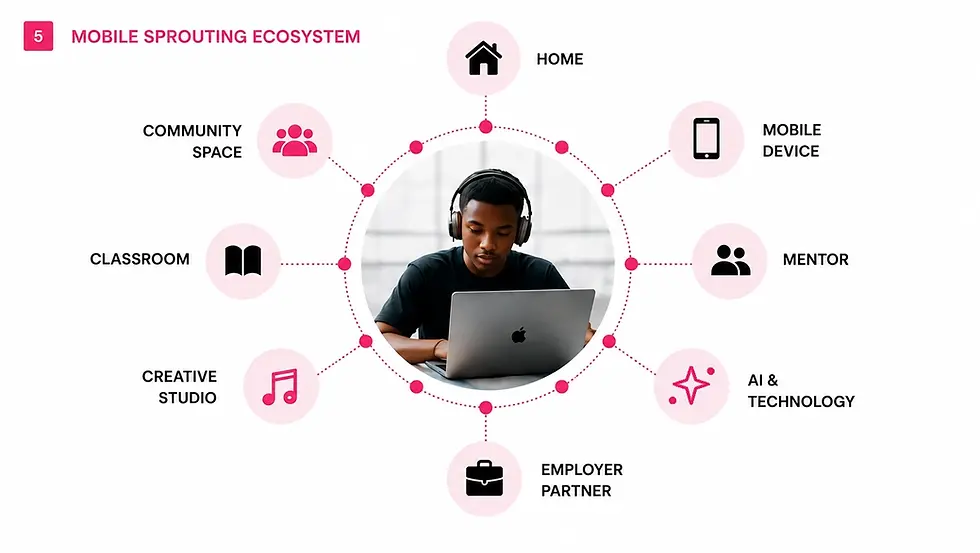


Systems Thinking Framework
The deeper the research became, the less the organization itself appeared to be the center of the solution.
Capability emerged across relationships extending far beyond any single institution.
The opportunity therefore wasn't expanding educational programming.
It was designing stronger connections between the environments where capability naturally develops.
INSIGHT
The Turning Point
One insight continued resurfacing throughout discovery.
Organizations often behave as though capability is something they deliver.
The research suggested something fundamentally different.
Organizations don't create capability.
They create the conditions where capability can emerge.
That realization expanded the organization's role.
Instead of becoming the center of workforce development, Impact Studios became one participant within a broader ecosystem supporting continuous human growth.
That subtle shift changed the direction of every strategic recommendation that followed.
Every project has a moment where the problem changes.
This was that moment.
Initially, the work focused on improving educational programming.
Research demonstrated that educational programming alone could never prepare individuals for careers that continuously evolve.
People build capability through repeated interactions across multiple systems.
Schools introduce learning.
Communities reinforce it.
Mentors accelerate it.
Employers apply it.
Technology personalizes it.
Reflection sustains it.
The project stopped being an education strategy.
It became a capability strategy.
FUTURE WORKFORCE FRAMEWORK


Reflection
Discovery fundamentally changed how I think about workforce development.
Organizations often prepare people for today's opportunities.
The future demands something different.
It requires designing systems that help people adapt to opportunities that haven't been defined yet.
That's where strategic design creates its greatest value.
Not by predicting the future.
But by designing systems capable of evolving alongside it.
STRATEGY
Designing the Capability Ecosystem
Discovery answered an important question.
How does capability develop?
The final phase asked an even larger one.
How might an organization intentionally design for it?
The solution was never intended to become another educational initiative.
It became a framework for helping people continuously develop new capabilities throughout changing careers, industries, and technologies.
Every design decision was evaluated against a single principle:
Does this strengthen a person's ability to keep learning long after this program ends?
That question became the foundation for the final strategy.
The objective wasn't to prepare people for their first career.
It was to help them continuously prepare for every career that follows.
Rather than positioning Impact Studios as the center of workforce development, the proposed model placed the organization within a broader ecosystem of contributors.
Capability would emerge through relationships connecting:
• Community organizations
• Educational institutions
• Employers
• Mentors
• Families
• Emerging technologies
• Distributed learning environments
• Personalized development pathways
Instead of delivering isolated educational experiences, the organization would help sustain continuous participation in an interconnected learning ecosystem.
Capability became something people cultivate over time rather than something organizations deliver through individual programs.
Capability Ecosystem
The proposed ecosystem intentionally distributed responsibility for workforce development across interconnected environments.
Learning became continuous.
Relationships became infrastructure.
Capability became the strategic objective.
The organization shifted from provider to ecosystem participant.

OUTCOMES
Project Outcomes
The value of this engagement extended beyond a single recommendation.
Research, systems thinking, and strategic design produced a collection of interconnected deliverables that established a shared understanding of how organizations can intentionally cultivate long-term workforce capability.
Each artifact contributed to a broader organizational strategy designed to support continuous learning, adaptability, and ecosystem collaboration.
This engagement produced a research-informed workforce capability strategy supported by qualitative research synthesis, systems mapping, ecosystem frameworks, strategic recommendations, organizational models, and future-state experience concepts.
Together, these deliverables established a shared understanding of how workforce capability develops across interconnected environments, enabling future organizational decisions to prioritize adaptability, continuous learning, ecosystem partnerships, and long-term organizational resilience rather than isolated educational programming.
The outcome was not a collection of disconnected artifacts.
It was an integrated strategic framework grounded in evidence and designed to evolve alongside changing workforce needs.
Key Strategic Deliverables
- Qualitative Research Synthesis
- Workforce Ecosystem Mapping
- Systems Thinking Framework
- Organizational Strategy
- Future-State Workforce Model
- Strategic Recommendations
- Capability Development Framework
- Experience Concepts
- Executive Presentation Materials
The deliverables documented the strategy.
The strategy strengthened the organization's ability to continuously develop capability.
FRAMEWORK
Designing for Adaptability
One realization continued shaping every recommendation.
Organizations shouldn't attempt to predict every future workforce need.
They should become capable of adapting alongside those changes.
The future isn't something organizations predict.
It's something they prepare themselves to adapt to.
That principle informed every element of the proposed framework.
It emphasized:
• Continuous learning
• Adaptive educational pathways
• Personalized development
• Reflective practice
• Distributed knowledge
• Technology-supported learning
• Community participation
• Organizational flexibility
Together, these components created a workforce ecosystem designed to respond to uncertainty rather than eliminate it.
The framework wasn't simply a workforce strategy.
It was an adaptive capability system.
Adaptive Capability Framework
The framework intentionally distributes learning, decision-making, and capability development across interconnected environments rather than concentrating responsibility within a single organization.
Continuous Learning
Support ongoing capability development beyond formal education.
Adaptive Pathways
Allow learning experiences to evolve alongside changing technologies and careers.
Technology-Supported Learning
Community Participation
Use technology to strengthen access, personalization, and continuous development.
Recognize that capability develops through relationships extending beyond organizational boundaries.
Organizational Flexibility
Reflective Practice
Create systems capable of evolving rather than remaining fixed.
Encourage continual learning through experience, evaluation, and adaptation.

Executive Value Created
Established a scalable workforce capability framework enabling organizations to respond more effectively to technological change, evolving labor markets, and continuous workforce development.
IMPACT
Organizational Impact
The visible outputs included ecosystem models, strategic recommendations, workforce frameworks, and conceptual service designs.
Those weren't the real outcome.
They were evidence of a larger organizational shift.
The greatest contribution wasn't proposing new educational services.
It was redefining how organizations intentionally cultivate capability.
The engagement established a foundation for:
• Continuous workforce development
• Stronger organizational partnerships
• Technology-enabled learning
• Community-supported capability building
• Lifelong professional development
• Organizational adaptability
• Future-oriented strategic planning
The work ultimately repositioned workforce development as an organizational capability rather than a collection of educational interventions.
Strategic Value Created
Continuous Workforce Development
Strengthened Organizational Partnerships
Technology-Enabled Learning
Community-Based Capability Building
Long-Term Professional Development
Organizational Adaptability
Future-Oriented Strategic Planning
Organizational Alignment
Established a shared understanding of workforce capability across stakeholders and strategic partners.
Systems Thinking
Connected education, employers, communities, and technology into a unified organizational strategy.
Adaptive Learning
Shifted workforce development toward continuous capability building rather than static educational programming.
Future Readiness
Positioned organizational adaptability as the primary measure of long-term workforce success.
Executive Perspective
Organizations frequently ask:
What skills will people need next?
The research suggested a better question.
How do we build systems that help people continuously develop whatever capabilities the future requires?
That subtle shift transforms the role of strategic design.
Organizations stop reacting to change.
They begin building the capacity to evolve with it.
Capability becomes a strategic asset.
Adaptability becomes organizational resilience.
REFLECTION
Why This Project Matters
Looking back, this project marked one of the earliest examples of thinking that continues to shape my work today.
Although completed years before today's conversations surrounding AI, adaptive learning, and workforce transformation, the engagement consistently approached capability as a systems challenge rather than an instructional challenge.
That perspective has only become more relevant.
Organizations increasingly need environments where learning, technology, collaboration, and human development reinforce one another continuously.
This project fundamentally changed how I think about strategic design.
Not as a discipline focused solely on improving existing systems.
But as one capable of imagining systems that do not yet exist.
Preparing people for the future begins by designing systems capable of learning alongside them.
At first glance, this appears to be a workforce development initiative.
It isn't.
It's a case study in organizational foresight.
The educational concepts are simply the visible artifacts.
The deeper work explored how organizations intentionally design adaptive ecosystems that help individuals, communities, and institutions continue developing capability as technology and society evolve.
Many of the ideas explored throughout this engagement—including adaptive learning pathways, ecosystem partnerships, distributed education, and technology-supported capability development—have since become central themes in workforce transformation.
That continuity reinforces an important belief that runs throughout this portfolio.
My work has consistently focused on designing systems that prepare organizations not only for today's challenges, but for tomorrow's opportunities.
Beyond This Chapter
This project answered one of the broadest questions explored throughout this portfolio:
How do organizations intentionally build capability?
It demonstrated that preparing people for the future requires more than expanding educational programs.
It requires designing systems that help individuals, organizations, and communities continuously learn, adapt, and grow together.
The future isn't built by predicting every change ahead.
It's built by creating systems that help people continue learning regardless of what changes next.
That principle continues to shape how I approach strategic design, enterprise transformation, organizational capability, and the creation of systems that enable people to succeed long after a project's initial delivery.
This chapter represents more than a workforce strategy.
It demonstrates a way of thinking.
One that begins by understanding how people learn, expands through understanding the systems that shape their experiences, and ultimately focuses on strengthening an organization's ability to continuously learn, adapt, and evolve.
That progression has become the foundation of every engagement presented throughout this portfolio.
Whether the challenge involves healthcare, enterprise technology, digital products, workforce development, or community ecosystems, the approach remains consistent.
Understand people.
Reveal the systems influencing their experiences.
Clarify the organizational relationships shaping those systems.
Then design the conditions that allow capability to emerge, mature, and endure.
That is the throughline connecting every chapter of this portfolio.
It is the perspective that continues to shape how I approach strategy, design, and organizational transformation.
NEXT CHAPTER
Continue to Chapter Seven
Designing future-ready organizations requires more than helping individuals develop new capabilities.
Long-term resilience emerges when communities, mentorship, relationships, and shared ownership continue reinforcing those capabilities long after an initiative formally concludes.
That realization leads to the next chapter.
Capability becomes sustainable when people begin strengthening one another.
Chapter Six explored how organizations intentionally cultivate capability through adaptive systems.
Chapter Seven expands that perspective beyond organizational boundaries.
It examines how mentorship, community participation, distributed leadership, and shared responsibility create ecosystems capable of sustaining growth across generations of people, organizations, and communities.
Together, these chapters illustrate an important progression.
Organizations learn.
Communities sustain.
Capability endures.
Next Chapter
Designing a Scalable Community & Mentorship Ecosystem
Exploring how communities become self-sustaining systems that continuously create opportunity, strengthen relationships, and cultivate long-term organizational and human capability.